
 ,
,
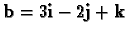 , and
, and
 :
:
Problem 2. Given the points
 find the volume of the parallelepiped with adjacent edges

Problem 3. Find both parametric and symmetric equations of the line that satisfies the given conditions.


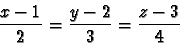
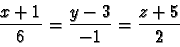
Problem 6. Identify and sketch the graph of each surface
Problem 7. A surface consists of all points  such that the distance from to the plane
  is twice the distance from to the point
  . Find an equation for this surface and identify it.
Problem 8. Sketch the curve with vector function

Problem 9. The helix
 intersects the curve
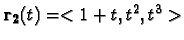 at the point
  . Find the angle of intersection of these curves as well as a curvature of each curve at the point of their intersection. Also, find the unit normal vector to r1(t) when t=0.
Problem 10. A particle starts at the origin with initial velocity  and its acceleration is
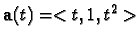 . Find its position function.
Problem 11. For the function
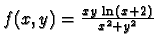
 .
.
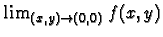 if it exists.
Problem 12. Sketch several level curves (surfaces) of the function

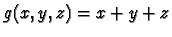
Problem 13. Suppose that
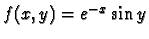 . Show that the function satisfies the differential equation
  .
.
Problem 14. Find a given partial derivative.
 and
and
 for
for
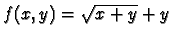 .
.
 for
for
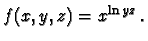
 for
for
